


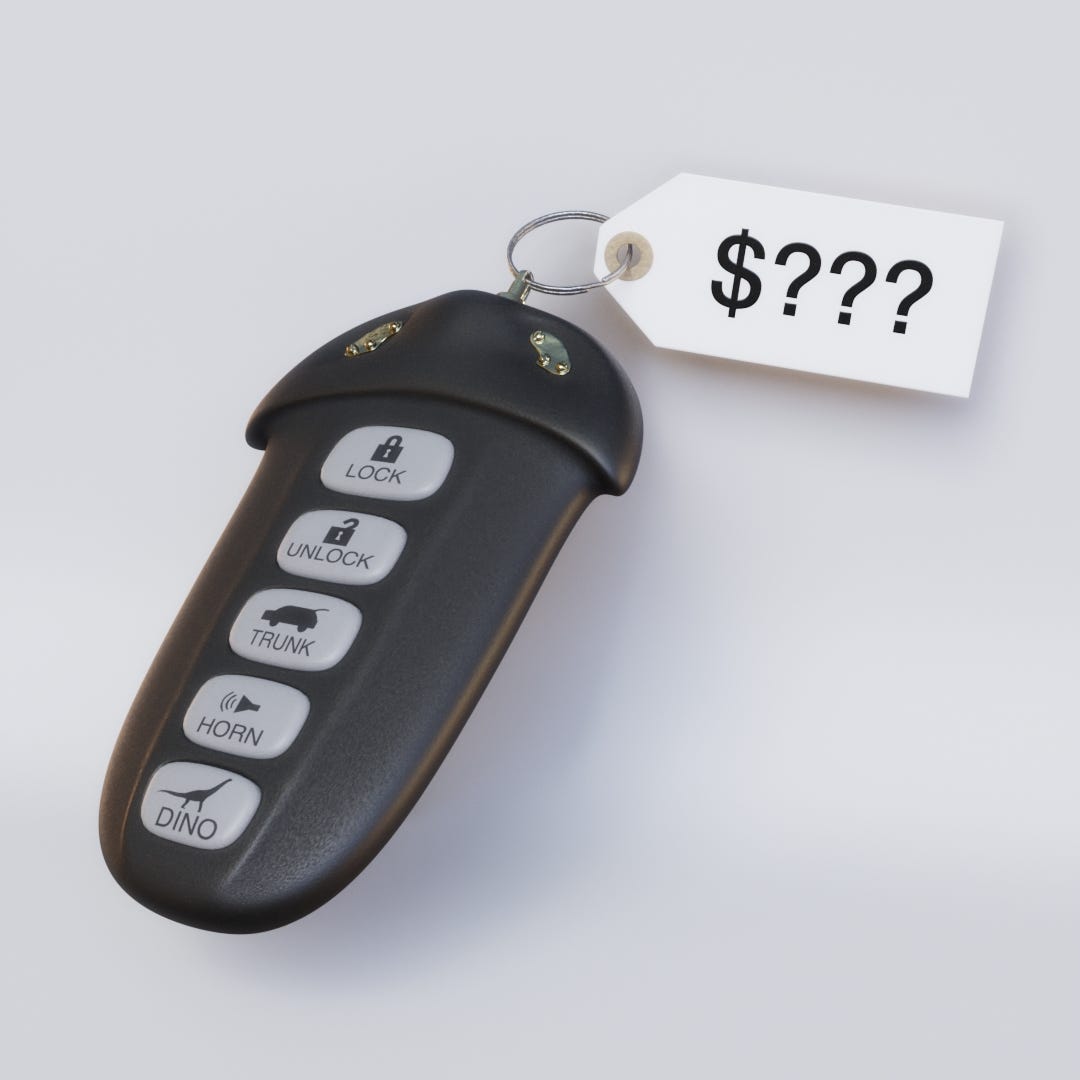
We have four young adult drivers in our family, in addition to my wife and myself, and our two primary cars each have only a single key fob. This leads to a lot of trading fobs between drivers (and occasional frustration when someone drives off in one car while also inadvertently carrying the fob for the other car as well.) However, I had not previously had an additional key fob made for either car, because the cost quoted to me by the dealership was over $300.
That approach ceased to be practical the day the key fob to my car disappeared.
There was significant dispute as to who had last had the fob, and everyone insisted they had returned it to the key holder after using it. But the thing that was clear was that the fob was missing, and without it my car was not drivable.
It’s a fundamental premise of Value Based Pricing that the value of something is measured compared to your next best options. With my car unwilling to start, my next best options were very expensive: Have it towed to a dealership where they would then charge me $300+ for a new key. Get a new car.
So, I took the least expensive (though still expensive) option and called a mobile automotive locksmith who would come out in person and make a new key.
How much?
$350.
It was cheaper in both time and money than having it towed to the dealership, though not much. In this sense, even as I gritted my teeth at the expense, I had to admit the locksmith had his pricing dialed in. He was taking full advantage of my willingness to pay and was still providing a better value than my next best option.
Once I had him there, working on the car, I asked him how much it would cost to have him make a second key fob. I figured that if I had him out there anyway, I might as well eliminate the frustrations of six people sharing a single key fob.
How much?
$350.
How about $150 for the second one, I asked. $500 total.
He considered, then offered $200 for a second one.
Nope. It’s got to be $150. Otherwise, I’ll just stick with the one.
He called his boss, then agreed. $500 for two key fobs.
Behind this negotiation are two key pricing lessons.
The first lesson I already described: When your potential customer has a problem where all the other solutions are very expensive and/or inconvenient, you have a lot of pricing power. All the mobile locksmith needed to do in order to get my business was be less expensive than having the car towed to a dealership and paying them to program a new fob. By pricing slightly less than the cost of both towing the car and having the dealership provide the fob, they maximized their profits while still winning my business.
However, once the locksmith was on site, there’s another important pricing lesson at play: The power of add-on pricing with an already acquired customer.
What is your most expensive piece of marketing? Acquiring a customer.
So once you have acquired a customer, it makes sense to maximize that customer’s total purchase. This is even more the case here, where the locksmith had already incurred the cost of driving out to my house to work on my car.
If he provided me with a second key fob, his costs were the physical fob (which I have to assume is actually quite low) and the addition of perhaps ten additional minutes of work at a stop he had already traveled to. In that sense, the discounted second fob might actually be higher profit than the full price first fob, which came with the cost of customer acquisition and travel.
I knew that he would probably accept a significantly lower price for that second fob for that reason. And indeed it would have been smart for him to offer a “buy a second fob for 50% off” option to all customers in order to increase his average total revenue per visit.
If you’re setting prices for a business, you need to make sure that your minimum revenue per sale is as high as possible. That means figuring out what the customer’s next best option is and pricing to offer a savings versus that next best option, but capturing as much of the value as you’re delivering to the customer as possible. This makes your work in acquiring the customer and making that first sale pay off.
However, you also want to offer attractive up-sell opportunities: bundles (which is essentially what I negotiated with a discounted second fob), upgrade options, a “good, better, best” product or service array. That is how you increase your average revenue per sale and make your whole business more profitable. It is usually more profitable to sell more to each existing customer than it is to have to go acquire additional customers.